HAKA: Keck Observatory’s Deformable Mirror Upgrade
The Pieces
High-Order Deformable Mirror
The centerpiece of HAKA is the replacement of the original 349-actuator Xinetics deformable mirror with a custom 2,844-actuator ALPAO mirror. The new mirror uses a 60 × 60 actuator grid, providing substantially finer spatial control of the wavefront and allowing the AO system to correct higher-order atmospheric aberrations that could not be adequately addressed by the original mirror. In addition to the increased actuator density, the ALPAO mirror provides almost 10x greater stroke compared to the original Xinetics mirror. All these improvements increase the range and precision of the wavefront corrections while reducing the likelihood of actuator saturation under challenging observing conditions.
Low and High-Order Wavefront Sensor
To take full advantage of the new deformable mirror, HAKA also includes an upgrade to the Shack-Hartmann wavefront sensor (SHWFS). Without this upgrade, the Keck AO system would not be able to measure the wavefront to accurately take advantage of the higher actuator density of the deformable mirror.
The upgraded system is outfitted with a high order 57 × 57 lenslet configuration for the best correction on bright stars and a low order 29x29 lenslet to preserve and im;prove the magnitude limits, compared to the 20 × 20 sampling of the original system. The wavefront sensor relay optics were redesigned to increase the pupil size on the lenslet array, enabling the finer spatial sampling required for high-order wavefront correction.
Upgraded Real-time Controller
The upgrades to the defomrable mirror and wavefront sensor increase the data products of the system by multiple magnitudes. Going from measuring ~400slopes from the other SHWFS and uising 349 actuators to correct to 2844 actuators and roughly 6000 slopes. The reconstructor of this new system is 3 orders or magnitude larger in size and scale. This is on of the reasons upgrades to the real time controller were necessary to handle the larger data flow and new hardware.
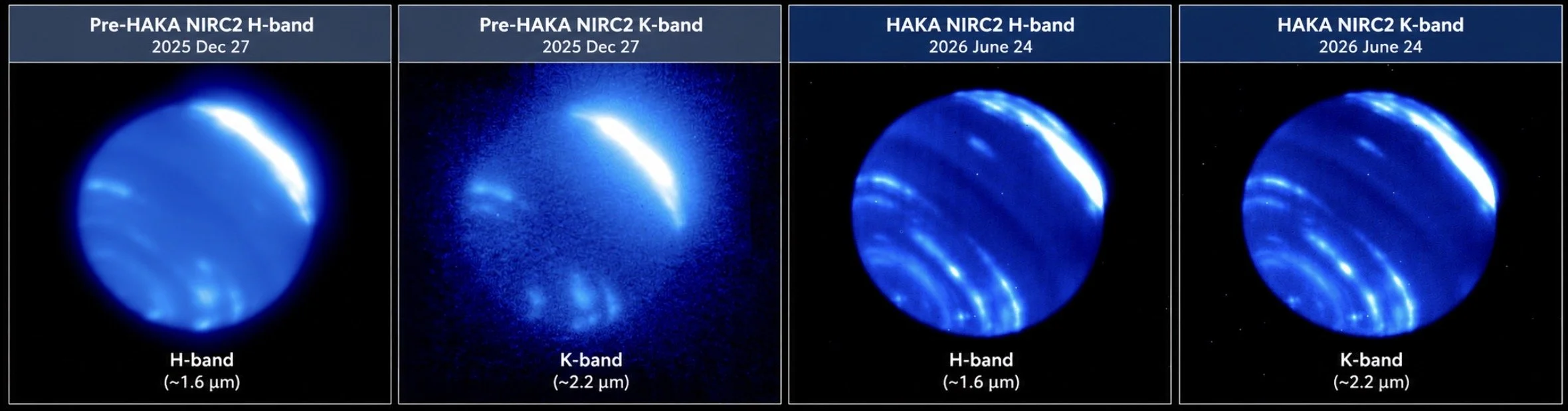
W. M. Keck Observatory (WMKO) is home to the world's most scientifically productive adaptive optics (AO) systems due to the continuously upgraded AO technology and expanding set of AO-fed science instruments. The AO system’s hardware linchpin – the deformable mirror (DM) – was installed in the early 2000’s and its small number of actuators now limits the overall performance of the Keck II AO system. A full AO system project called High order Advanced Keck Adaptive optics (HAKA) upgrades the existing 349-actuator DM with a state-of-the-art 2900-actuator DM. This change will give Keck a unique observing opportunity to directly imaging and spectroscopically characterizing populations of old, cold exoplanets that are not accessible to any direct imaging facility, ground or space, as well as enable Z-Band AO corrections to probe the atmospheres of our Solar System’s ice giants and map the surfaces of the Galilean moons. The HAKA science program will be carried out by existing and up-coming AO science instruments on the Keck II telescope:
Near-infrared camera (NIRC2)
Single-mode fiber-fed spectrograph (KPIC + NIRSPEC)
Mid-infrared coronagraphic integral field spectrograph (SCALES)
Fiber-fed high-resolution spectrograph (HISPEC).
HAKA builds on a recent series of successful upgrades to the Keck II AO system including a new real-time controller, high-speed wavefront sensor camera, and near-infrared pyramid wavefront sensor. With HAKA, these upgrades transform the Keck II AO system from general purpose AO to a state-of-the-art planet-characterization machine with far-reaching capabilities for all science cases even moving to optical wavelengths.
The current Keck 2 AO DM is a 20x20 actuator, 7 mm spaced, Xinetics DM. The HAKA DM is an upgrade with a 58x58 actuator, 2.5 mm spaced ALPAO DM; this oversized to fit an11.4 m diameter and 20 cm spacing at the Keck primary mirror. These two DMs can be directly swapped without any changes to the AO bench science optical path. This ALPAO DM is currently being developed and tested by multiple groups around the world. The ALPAO DM has larger stroke and lower hysteresis than the current Xinetics DM, including operation down to -30C (allowing for a future cold AO system operation option).
The HAKA DM will require an upgrade to the current Shack-Hartmann Wavefront Sensor (SHWFS). The Shack-Hartmann wavefront sensor pupil relay optics will be redesigned to produce a 2.8 times larger pupil image on the lenslet array. The existing lenslet arrays, and reducer optics in front of the OCAM2K camera, are large enough to utilize the larger pupil; the distance between the field stop and lenslet array will be increased. The main change will be using 56 subapertures and a total of 224 pixels instead of the current SHWFS, which only utilizes 20 subaperatures.

Redesign needed for the current Keck 2 AO SHWFS. The new relay optics will increase the beam size on the lenslet array to illuminate 56 subapertures instead of the current 20
Recent Publications
Wizinowich et al., Keck Adaptive Optics Current and Future Roles as an ELT Pathfinder
Lilley et al. Keck AO high order wavefront sensing and control: opto-mechanical design
Team Leads
Dr. Antonin Bouchez, Principal Investigator, W. M. Keck Observatory
Eduardo Marin, Project Manager, W. M. Keck Observatory
Prof. Rebecca Jensen-Clem, Project Scientist, University of California - Santa Cruz
Microgate, Real-time Controller Lead, Contractor
Dr. Jim Lyke, Adaptive Optics Operations, W. M. Keck Observatory
Dr. Charlotte Guthery, Adaptive Optics Scientist, W. M. Keck Observatory
Paul Richards, Software Engineer, W. M. Keck Observatory
Ed Wetherell, Electrical Engineer, W. M. Keck Observatory
Scott Lilley, Opto-Mechanical Engineer, W. M. Keck Observatory